Microéquilibre is a French laboratory specializing in micronutrition that develops and markets dietary supplements recommended by healthcare professionals.
What role does sugar play in obesity?
What role does sugar play in obesity?
Obesity is now a global epidemic, and its prevalence has been increasing since 1980. In 2014, there were more than 1.9 billion overweight adults, 600 million obese adults, and 41 million overweight or obese children under the age of 5. France is following the same trend as the rest of the world. Body mass index (BMI) is calculated based on an individual's weight and height (weight (in kg) / (height (in cm))²) and is used to assess body size.
A score between 25 and 30 indicates overweight, and between 30 and 40 indicates obesity. A score of 30 corresponds to moderate obesity and 40 to morbid obesity. Beyond the problems of excess weight, obesity is a major risk factor for many diseases, including diabetes, cardiovascular disease, fatty liver disease, dyslipidemia, cancer, etc. Obesity is most often the result of an energy imbalance between calories consumed and calories expended, and an increase in the consumption of foods high in sugar and fat at the expense of healthier foods.
Today, sugar is an integral part of our diet and its consumption is only increasing, even among young children. It is estimated that the average French person consumes between 30 and 35 kilograms of sugar per year, compared to 26 in 1950 and 5 in 1850. While sugar should not be demonized because it provides the body with necessary energy, its overconsumption is harmful to health. The consequences of excessive sugar consumption are numerous and include obesity and other metabolic disorders.

What is sugar?
Carbohydrates, more commonly known as sugars, are molecules whose function is to provide energy to the body in the form of calories. There are two types of carbohydrates: simple (or monosaccharides) and complex (polysaccharides and disaccharides). Simple carbohydrates such as glucose, fructose, and galactose are non-hydrolyzable molecules, meaning they cannot be broken down into smaller molecules. Complex carbohydrates, on the other hand, are formed by linking simple carbohydrates together. These include disaccharides such as lactose and sucrose, which are composed of two simple carbohydrates, and polysaccharides (starch, cellulose, glycogen, etc.), which are composed of more than two simple carbohydrates. Only simple carbohydrates and disaccharides in complex carbohydrates have sweetening power. Polysaccharides do not.

What sugars and in what forms?
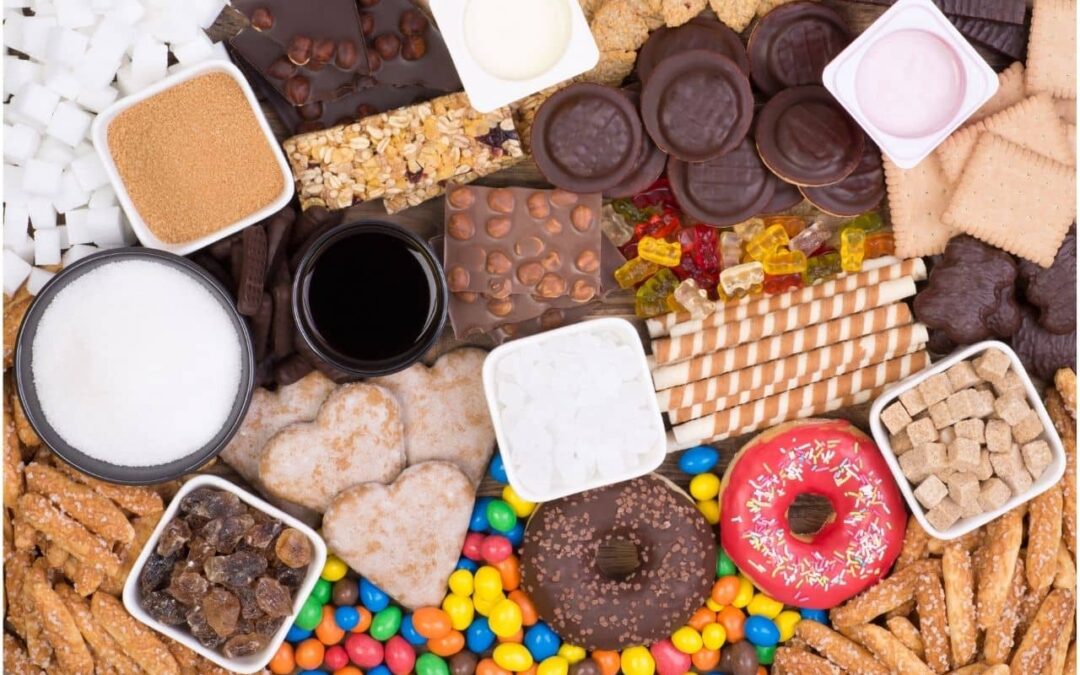
Sugars are now ubiquitous in our diets. They come in several forms, found naturally in fruits and honey, and also in the form of refined sugar in processed products such as cookies, drinks, candies, etc. Processed foods contain the highest amounts of sugar. Sugar is very often added to these foods during manufacturing.
The most common sugars include the following:
Sucrose, or table sugar, is the best known. It is the sugar par excellence and the one used in the food industry for making cakes, drinks, etc. It consists of glucose and fructose and comes from sugar beets or sugar cane. It has a sweetness rating of 100, which is the maximum.
Sweetness is the sweetening value of one chemical compound compared to another. Sucrose is most often used as the reference solution, with a sweetness value of 100.
Glucose is also found naturally in the body. The food industry extracts it from starch through hydrolysis. It has a sweetness rating of 70.
Fructose is a natural sugar found in fruits and honey. It is also found in significant quantities in ultra-processed foods. The food industry extracts it and adds it to foods. It has a high sweetening power of between 130 and 150.
Glucose syrup is produced by breaking down starch. It has a low sweetening power of 27 to 55.
Finally, glucose-fructose syrup, or isoglucose, or high-fructose corn syrup (HFCS), is produced by processing glucose syrup and has a sweetness similar to that of sucrose. It contains a proportion of fructose and is widely used by manufacturers.
Although they have a similar caloric value, all these sugars differ in their sweetness, their physical and chemical characteristics, and therefore their effects on health. Sugars added to foods and beverages during manufacturing by industry or by consumers are the most harmful to health, and their consumption continues to rise. They are believed to be partly responsible for the global obesity epidemic.

How are sugars digested and absorbed?
Once swallowed, carbohydrates undergo a number of physical and chemical transformations. As they pass through the mouth and then the digestive tract, they are broken down into small molecules. This is a necessary step, as only simple sugars can be absorbed by the intestine.
First, complex carbohydrates are broken down into simple carbohydrates consisting of fewer units when they come into contact with the amylase contained in saliva. Then, once in the intestine, pancreatic amylase and other even more specific enzymes such as lactase or saccharase take over and break down the carbohydrates into even smaller units. Ultimately, this produces relatively small sugars such as glucose, fructose, and galactose, which can be absorbed by the cells of the intestine and thus enter the bloodstream to provide sufficient energy to all the organs of the body. Glucose is the main source of energy for cells.
The intestinal wall contains intestinal cells, called enterocytes, which use specific transporters to move the reduced sugars from the digestive tract into the bloodstream.
Once in the blood, glucose increases blood sugar levels. Blood sugar levels correspond to the amount of glucose in the blood and are measured in grams per liter of blood. When fasting, the value should be between 0.8 and 1 gram per liter of blood. If there is too much glucose, this is called hyperglycemia, while if there is not enough, it is called hypoglycemia. Blood sugar levels are controlled simultaneously with the release of hormones by the pancreas, small intestine, and colon. Hormones are molecules produced by an organ that are released into the bloodstream to transmit a message to a target organ. The pancreas releases insulin and glucagon, while the small intestine and colon release GLP-1. Insulin is a hypoglycemic hormone produced by the pancreas that is released into the blood after a meal to reduce blood sugar levels, while glucagon is a hyperglycemic hormone that is released to increase blood sugar levels. Finally, GLP-1 is a hormone in the colon whose role is to increase insulin secretion after a meal.
Once in the blood, glucose travels to various organs. The liver stores glucose for the body in the form of glycogen and is responsible for supplying glucose to cells. Muscles store glucose in the form of glycogen for their own use. Adipose tissue, or fat cells, also stores glucose, but in the form of triglycerides, more commonly known as fat. Finally, the brain also consumes glucose, using 60% of the body's glucose. Since it cannot store it, the liver supplies it with glucose.
When blood sugar levels are low, the pancreas releases glucagon, which increases blood sugar levels by drawing on the endogenous glucose reserves stored in the organs. Conversely, when blood sugar levels rise, the insulin released promotes the storage of glucose in the organs in the form of glycogen, ultimately reducing blood glucose levels.

What are the consequences of excessive sugar consumption?
Simple carbohydrates are most often referred to as fast sugars because they cause a rapid increase in blood sugar levels. Overconsumption leads to a loss of insulin sensitivity, which then becomes insufficient to bring blood sugar levels back down to their baseline. The glucose then remains in the bloodstream and is recovered and stored by adipose tissue in the form of fat. This leads to weight gain and, even more so, to obesity.
Beyond disrupting the system, overconsumption has significant consequences for the gut microbiota. It promotes dysbiosis, an imbalance in the gut microbiota, and is likely to cause a decline in bacterial diversity.
Overconsumption is also harmful to the brain. A 2012 study in rodents showed that a high-fructose diet impacted memory, learning, and neural communication. These observations have been replicated in humans, and the impact on brain function is dependent on sugar consumption. The higher the consumption, the greater the impact on cognitive function.
Should we stop eating sugar?
Nowadays, it is more important than ever to review your sugar intake. ANSES recommends that adults consume no more than 100 grams of sugar and no more than one sugary drink per day. Above this level, sugar consumption has an impact on the body. However, as glucose is the body's main source of energy, it should not be eliminated entirely.
It is therefore important to find the right balance, to opt for natural sugars and to be mindful of hidden sugars and sweeteners. The latter give a sweet taste to food and drink and were developed to combat diabetes and obesity. They are mostly synthetic and are characterized by their high sweetening power and lack of calories. However, it has now been shown that they contribute to weight gain and other metabolic disorders. The consumption of non-caloric artificial sweeteners leads in particular to the development of glucose intolerance and dysbiosis of the intestinal microbiota. Glucose intolerance occurs when the body becomes insensitive to insulin and no longer assimilates glucose properly. This results in an increase in blood glucose and can in some cases lead to the onset of diabetes. Reducing sugar consumption should not be done in favor of these sweeteners, which do not appear to be as beneficial to health as they seem.
Sources:
The different types of sugars. Nutrition. GOOD TO EAT, GOOD TO KNOW. Available at: https://www.lanutrition.fr/les-differents-types-de-sucres
Sugars in food. ANSES. Available at: https://www.anses.fr/fr/content/sucres-dans-l%E2%80%99alimentation
Sugar and food. PLANET VIE. Available at: https://planet-vie.ens.fr/thematiques/sante/sucre-et-alimentation
Digestion and assimilation of carbohydrates. PENSER SANTE. Available at: https://www.pensersante.fr/digestion-et-assimilation-des-glucides
Lenny R. Vartanian, PhD, Marlene B. Schwartz, PhD, and Kelly D. Brownell, PhD. Effects of Soft Drink Consumption on Nutrition and Health: A Systematic Review and Meta-Analysis. AJPH. 2006.
Discover more articles on the microbiota.

Partnership between Microequilibre and Nahibu

Partnership between Bio-Recherche and Nahibu
Bio-Recherche Laboratories specialize in researching and marketing high-value-added dietary supplements whose effectiveness has been proven by clinical studies, most of which justify prescription by doctors.

Partnership between BioSavor and Nahibu
Nutritionally rich, BioSavor Superfoods are 100% natural foods that promote well-being and energy.
Take control of your diet with Shido.