

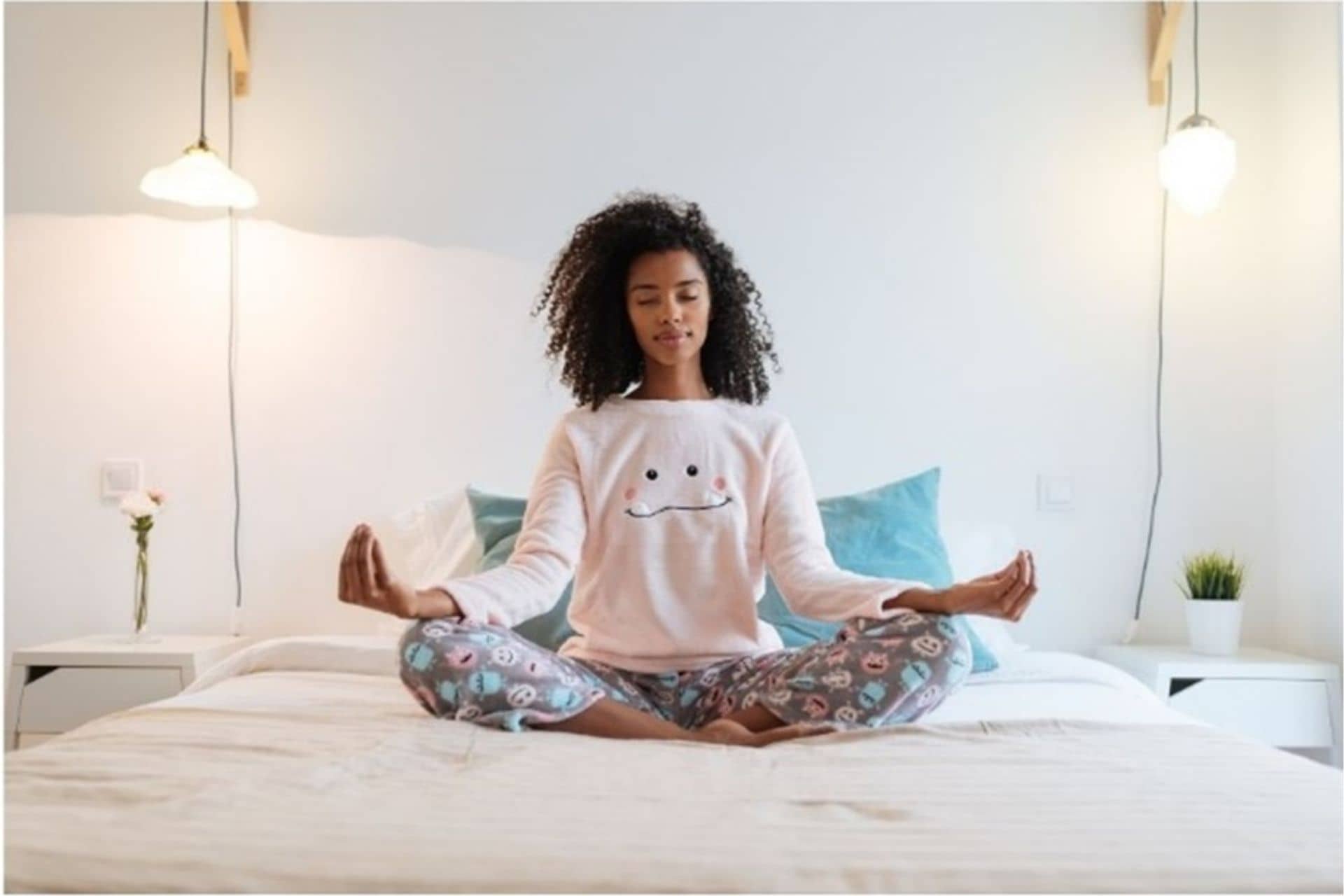
Meditation as a solution for reducing stress and anxiety?
Our current lifestyle exposes us all to stress: we hear more and more about mental overload and burnout. Juggling personal and professional life can be a big challenge! A stressful job with lots of meetings and responsibilities, a family to manage, sports or other activities: how can we keep up with everything? What’s more, we are constantly connected: emails, phones, social media, 24-hour news channels… all these channels are constantly sending us notifications. In this context, how can we find time to wind down and enjoy the present moment?
How to manage stress?
A study published by Santé Publique France revealed that the prevalence of anxiety in France was 13.5% in 2017. A previous study showed that mood disorders (depressive episodes, dysthymia, manic episodes) affected approximately 11% of men and 16% of women, and that anxiety disorders (generalized anxiety, agoraphobia, social phobia, panic disorders, and post-traumatic stress disorder) affected 17% of men and 25% of women.
Recently, the health crisis has increased feelings of anxiety around the world. The prevalence of anxiety rose to 26.7% during the first wave of COVID-19, twice the rate in 2017. It is urgent to find solutions to reduce these staggering figures.
So how can we reduce stress and anxiety? Could meditation be a solution to these problems? The number of retreats and courses dedicated to meditation has exploded in recent years, reflecting growing demand.
It is also increasingly recommended by the medical profession and has been democratized by the many books published on the subject and the various apps that allow people to practice using their cell phones.
What are the origins of meditation?
No one really knows when meditation first began. It is thought to have originated in Asian societies, which structured the practice. It is thought to have developed in Hindu traditions and then in the Buddhist religion in India, as well as in Taoist China, several millennia before Christ. References to the practice of meditation can also be found in other cultures and various religions such as Judaism, Islam, and Christianity.
In the West, it was the translation of philosophical texts from the East that first brought the concept of meditation to prominence in the 18th century. At that time, it was only a topic of discussion for intellectuals such as Voltaire and Schopenhauer.
It remained relatively unknown and rarely practiced until the 20th century, when it became more widespread. By distancing itself from religion, meditation adapted to the Western lifestyle. In the 1960s and 1970s, transcendental meditation was practiced by many celebrities, including the Beatles. However, it remained mainly associated with hippie culture and was not widespread in all circles.
In the 1990s, treatment programs for anxiety and depression were developed around meditation. A psychological approach combining meditation with behavioral and cognitive therapy has shown convincing effects on these disorders.
Nowadays, meditation is a relatively common relaxation activity. This is not surprising when you consider that its practice is associated with many positive effects on mental and physical health.
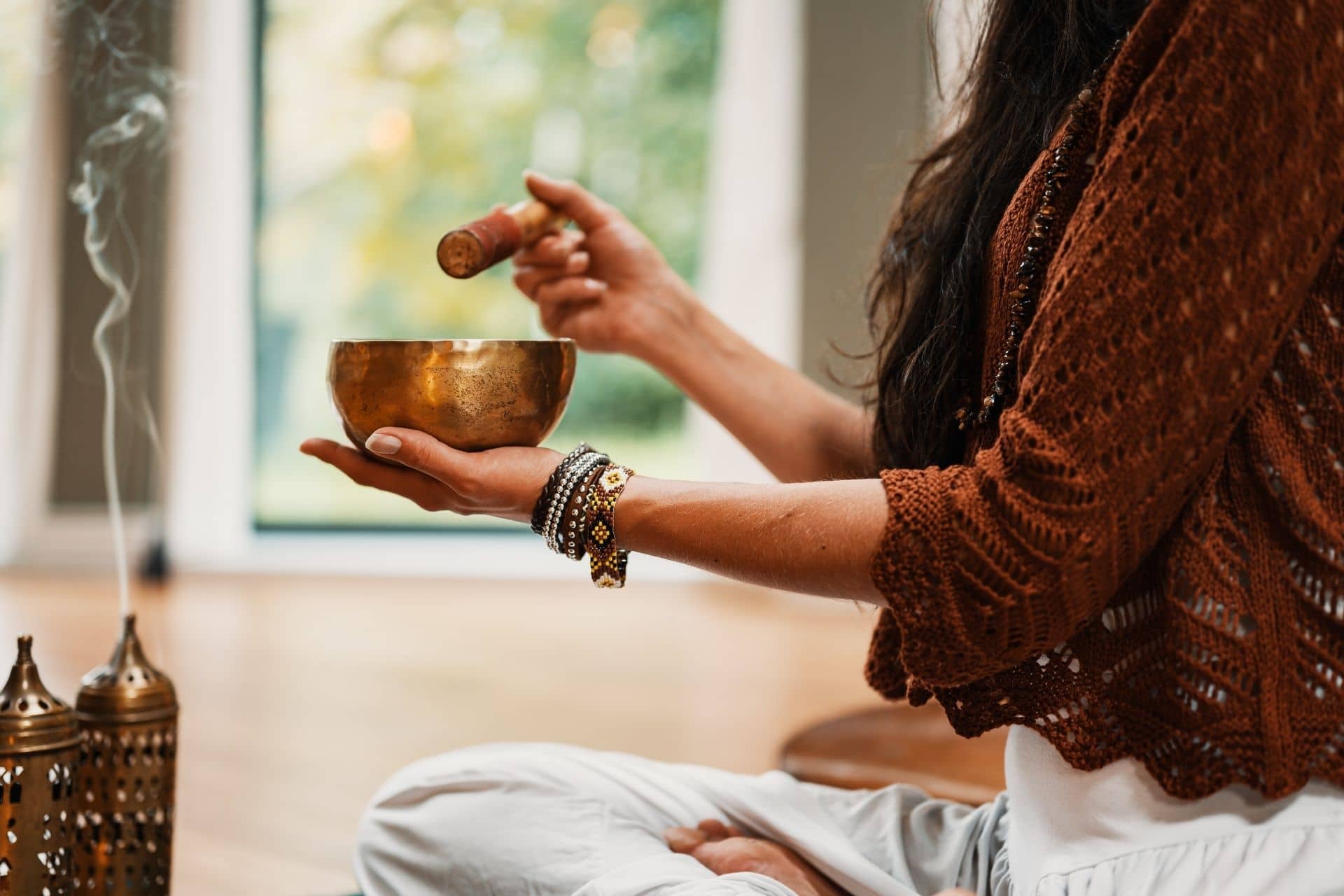
What are the different types?
There are many forms of meditation around the world. Depending on the location, religion, lifestyle, or personal preferences, meditation can be different and adapted to each practitioner.
Mindfulness meditation
The most widespread form of meditation in Western societies and the medical field is mindfulness, which consists of refocusing on the present. In today’s world, it is difficult not to project ourselves into the future, not to anticipate what might happen, or, conversely, not to dwell on memories or regrets… Mindfulness offers a way to connect with the present moment, forgetting the past and the future. It allows us to observe what is happening within us but also around us, without reacting to it, simply accepting it. It also allows us to become aware of certain mental patterns that could be harmful, such as the tendency to dwell on our failures, for example.
Focused attention meditation
There is also focused attention meditation, during which attention is concentrated on an object, a part of the body, a mantra, etc. If the mind wanders and thoughts arise, the goal is to refocus on the object of meditation, which then serves as an anchor for attention.
There are many variations of these types of meditation, and they can also be combined. Other practices exist, of course, but they are less common in Europe.
What is meditation for?
Meditation, in its spiritual and traditional dimension, allows you to access a new state of consciousness, to awaken. In Europe and the United States, meditation has largely been freed from its spiritual dimension, and its objectives are more about regulating emotions, particularly stress, gaining self-confidence, or getting through a difficult situation. The practice of meditation has adapted to the needs of Western societies. It can be integrated into an approach aimed at improving well-being and achieving happiness.
Meditation reduces stress, anxiety, and depression
A meta-analysis of 45 studies published in 2017 in the Journal of Psychiatric Research showed that the different forms of meditation studied reduced stress markers (cortisol, CRP or C-reactive protein, blood pressure, heart rate, triglyceride levels, and TNF-alpha—a pro-inflammatory factor). The effect on stress regulation is therefore very real.
A study conducted in the United Kingdom on 238 employees measured the effects of a mindfulness meditation program on smartphones on work-related stress over an eight-week period. Participants noted their levels of well-being and distress. The meditation program offered 10- to 20-minute sessions. The results showed that listening to these meditations several times a week for two months improved overall well-being, anxiety, and depressive symptoms. The more often the meditation was listened to, the greater the effects. What’s more, these effects persisted even after the intervention ended.
Is there a link between meditation and our gut?
The gut is home to many neurons that form the enteric nervous system. This nervous system regulates the functions of the digestive tract. The gut microbiota, composed of billions of microorganisms (bacteria, viruses, fungi, yeasts, etc.) that populate our gut, produces neurotransmitters during the fermentation of certain foods. Neurotransmitters are molecules that transmit messages from one neuron to another. The gut-brain axis, also known as the gut-microbiota-brain axis, enables constant communication between these two, or even three, organs. When under stress, who hasn’t experienced an increase or decrease in their bowel movements? This is proof that the brain and gut exchange information!
Take care of your microbiota with Nahibu.
The existence of the gut-brain axis would suggest that meditation, which reduces feelings of anxiety and stress, could influence our gut microbiota. A study published in December 2020 on elderly subjects with mild cognitive decline tends to confirm this hypothesis. The participants followed a mindfulness program for up to 9 months. The results showed that practicing mindfulness improved their cognitive functions and was also associated with a change in their microbiota. Meditation therefore appears to have many benefits and to have an overall effect on the body. It not only regulates stress markers such as cortisol, but also the composition of the gut microbiota!
How to meditate at home? Tips for beginners:
Where to practice?
Meditation is becoming increasingly accessible thanks to the publication of numerous books on the subject, as well as mobile apps and gadgets that make it easy to practice at any time.
With mobile apps, you can practice anywhere, even discreetly with your headphones on: at home, on public transportation, in line at the supermarket, at the office during your lunch break, etc.
If you don’t have an app, you can also practice mindfulness by sitting down, relaxing your body, and focusing on your breathing and the areas of your body that are in contact with the chair, floor, or bed. If you find it easier, focus on an object.
When to meditate?
There is no right or wrong time: morning or evening meditation, it’s up to you to find the time that suits you best. The ideal is to find a slot during which you can meditate regularly.
Don’t feel stressed? You can still practice, and it’s even recommended because your body and mind will be trained during a calm moment, and meditation can be even more effective when you feel overwhelmed. The practice can last from 5 to 30 minutes, or even longer if you have the time; the key is to be able to fit a session into your schedule. In the morning, it can help you start your day off right; at lunchtime, it can give you a break from the hustle and bustle of your day; and in the evening, it can regulate your sleep and help you sleep better.
What if I can’t do it?
One of the keys to meditation is to observe and accept thoughts, feelings, and sensations without reacting. We must welcome what is happening within us and around us, without judgment. There is no such thing as a bad meditation session; every session brings something. If you feel that your mind can’t stop thinking, that you can’t focus on the present moment, just observe and accept it.
Don’t set goals and feel guilty if you don’t achieve them; the practice itself is enough. And if you haven’t had time to practice, or haven’t felt like it, it’s okay, you can always do it another time!
Ready to balance your chakras and achieve happiness?
Meditation has finally found its place in the West, thanks to the many mobile apps and books that have made it accessible to everyone. In the medical field, it is often used as a complement to therapies and treatments for a number of disorders such as panic attacks, anxiety, depression, sleep disorders, but also chronic pain and tinnitus.
In our busy lives, it is very rare to be able to stop and observe, without doing anything. Meditation, in all its forms, has many virtues. Isn’t the first of these to teach us to enjoy the present moment?
Sources:
https://positivepsychology.com/history-of-meditation/
Mindfulness mediates the physiological markers of stress: Systematic review and meta-analysis. Pascoe MC, Thompson DR, Jenkins ZM, and Ski C. Journal of Psychiatric Research, 2017.
Mindfulness on-the-go: Effects of a mindfulness meditation app on work stress and well-being.
Sophie Bostock, Alexandra D. Crosswell, Aric A. Pratherb, and Andrew Steptoe. J Occup Health Psychol., 2019.
Mental awareness improved mild cognitive impairment and modulated gut microbiome. Wei Wei Thwe Khine, Miao Lian Voong, Ted Kheng Siang Ng, Lei Feng, Grishma Avinash Rane, Alan Prem Kumar, Ee Heok Kua, Ratha Mahendran, Rathi Mahendran, and Yuan-Kun Lee. Aging, 2020.
Discover more articles on the microbiota.
Take care of your microbiota with Nahibu.
Reading time: 8 min · Thank you for reading this article.
Discover the composition of your microbiome.
At-home test - Results within 4 to 8 weeks - Personalised scientific report